White Springtails
White Springtails are tiny, active and highly useful arthropods that are widely used as a bioactive cleanup crew in terrariums and vivariums. Their small white bodies, rapid movement and ability to thrive in moist environments make them one of the most popular choices for maintaining naturalistic enclosures.
Usually measuring only a few millimetres in length, White Springtails are small enough to move through soil, leaf litter and other areas of an enclosure that larger cleanup crew organisms cannot easily reach. They feed on fungi, mould, microorganisms and decomposing organic material, helping maintain a cleaner and more balanced bioactive environment.
Whether you’re an experienced terrarium keeper or setting up your first bioactive enclosure, White Springtails are an excellent addition to any naturalistic terrarium or vivarium.
What Are White Springtails?
White Springtails are tiny arthropods belonging to the group Collembola. They are commonly found in damp soil, leaf litter, compost and other environments containing moisture and decomposing organic material.
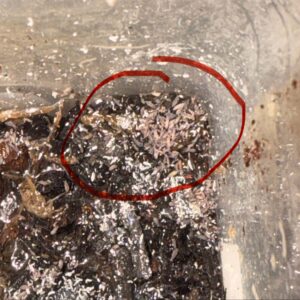
Their bright white colouration makes them particularly easy to identify against darker soil and substrate.
Despite their extremely small size, springtails are highly active. Many springtails possess a specialised structure called a furcula, which allows them to rapidly propel themselves through the air when disturbed.
Appearance
White Springtails are characterised by their tiny size and pale white appearance.
Typical characteristics include:
- Bright white to pale colouration
- Tiny body size
- Usually around 1–2 mm in length
- Compact segmented body
- Rapid movement
- Ability to jump when disturbed
- Large numbers within established cultures
Their small size allows them to occupy spaces throughout the substrate and leaf litter where larger cleanup crew organisms may not reach.
Natural Habitat
Springtails are found throughout the world and inhabit a huge variety of environments.
They are commonly associated with:
- Moist soil
- Forest leaf litter
- Gardens
- Compost
- Decaying vegetation
- Woodland environments
- Damp organic material
White Springtails thrive particularly well in moist environments containing fungi, microorganisms and decomposing organic matter.
Behaviour
White Springtails are active, fast-moving and highly adaptable. In established cultures, large numbers can often be seen moving across the surface of the substrate, particularly around food sources.
When disturbed, they can rapidly jump or scatter, creating the characteristic movement associated with springtails.
Their diet consists primarily of microorganisms and decomposing organic material, including:
- Fungi
- Mould
- Decaying plant matter
- Microbial material
- Organic debris
This feeding behaviour makes them extremely valuable as a bioactive cleanup crew.
White Springtail Care
White Springtails are relatively easy to culture and maintain when provided with consistent moisture and an appropriate food source.
A healthy culture should have:
- Consistent moisture
- Suitable ventilation
- Appropriate culture medium
- A reliable food source
- Protection from excessive drying
Maintaining moisture is particularly important because springtails are very small and can be vulnerable to dehydration.
The culture should remain damp without becoming excessively stagnant or waterlogged.
Feeding
White Springtails can be maintained on small amounts of suitable food.
Common foods include:
- Brewer’s yeast
- Yeast-based foods
- Decaying organic material
- Fungal material
Only small quantities should be added at a time. Overfeeding can encourage excessive mould growth and negatively affect the culture.
Bioactive Cleanup Crew
White Springtails are one of the most useful bioactive cleanup crew organisms for naturalistic enclosures.
Their tiny size allows them to access areas throughout the substrate, leaf litter and other parts of the enclosure. They help consume mould, fungi and small amounts of decomposing organic material.
White Springtails are particularly useful in:
- Bioactive terrariums
- Tropical terrariums
- Vivariums
- Reptile enclosures
- Amphibian enclosures
- Invertebrate habitats
- Naturalistic planted displays
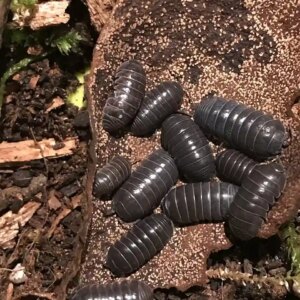
They can also work alongside suitable isopod species to create a more diverse and effective cleanup crew.
Colony Growth
White Springtails can reproduce rapidly under suitable conditions and may establish large, thriving cultures.
A healthy culture can contain thousands of individuals, allowing keepers to introduce springtails into new or established bioactive enclosures as required.
With consistent moisture, food and suitable environmental conditions, a springtail culture can remain productive for an extended period.
Once introduced into a suitable bioactive enclosure, White Springtails may also establish a continuing population when sufficient moisture, food and organic material are available.
Why Keep White Springtails?
White Springtails are an excellent choice for anyone looking for a small, productive and easy-to-maintain bioactive cleanup crew.
Key features:
- Bright white colouration
- Extremely small size
- Excellent bioactive cleanup crew
- Help consume mould and fungi
- Process decomposing organic material
- Rapid colony growth
- Easy to maintain
- Suitable for beginners
- Ideal for bioactive terrariums
- Useful in vivariums and naturalistic enclosures
- Fascinating jumping behaviour
- Can establish self-sustaining populations
Whether you’re establishing a new bioactive terrarium or maintaining an existing naturalistic enclosure, White Springtails are an essential cleanup crew addition. Their tiny size, rapid reproduction and ability to consume mould and fungi make them a practical and fascinating part of a healthy bioactive ecosystem.