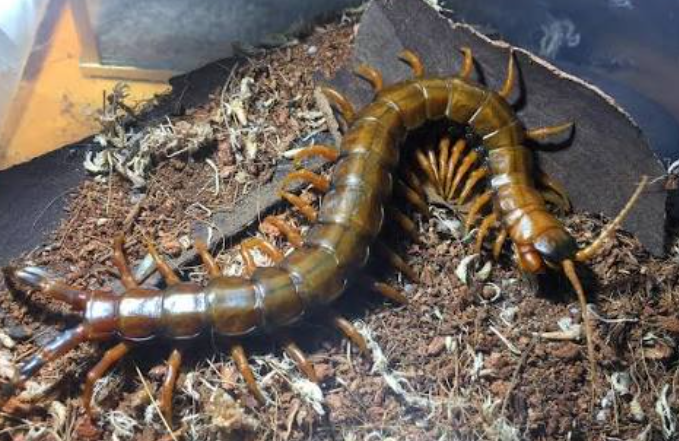
Cairns Green Form (Ethmostigmus Rubripes) (color may not be same as picture)
Cairns Green Form (Ethmostigmus rubripes) is a striking regional form of the Australian Giant Centipede, recognised for its bold banded body, contrasting colouration and powerful predatory behaviour. Associated with the tropical regions around Cairns and northern Queensland, this impressive centipede is highly sought after by experienced invertebrate keepers and collectors.
With its elongated body, contrasting bands, vivid legs and prominent venom claws, the Cairns Green Form is an impressive example of Australia’s diverse centipede fauna. Its active and predatory nature makes it a fascinating species to observe, although it should only be kept by experienced keepers who understand the risks associated with large venomous centipedes.
Please note: Colouration can vary considerably between individual specimens and may not be identical to the specimen shown in photographs.
Scientific Classification
- Scientific Name: Ethmostigmus rubripes
- Genus: Ethmostigmus
- Family: Scolopendridae
- Common Name: Australian Giant Centipede
- Form: Cairns Green Form
- Type: Terrestrial Centipede
Appearance
The Cairns Green Form of Ethmostigmus rubripes is a medium to large-sized centipede with the characteristic flattened body and numerous segmented legs associated with the species.
Typical features can include:
- Dark brown to black body colouration
- Contrasting lighter banding across the body segments
- Orange, yellow or reddish tones
- Bright orange to reddish legs
- Long, flattened body
- Numerous segmented body plates
- Prominent venom claws, known as forcipules
The contrasting body pattern gives this form its distinctive tiger-like appearance, making it a particularly attractive species for specialist invertebrate collections.
Colour Variation
Colouration can vary between individual centipedes depending on factors such as age, locality, development and individual variation.
The Cairns Green Form name refers to the regional form, but individual specimens may display different shades and patterns from those shown in product photographs.
Colour may not be the same as the picture.
Habitat & Distribution
Ethmostigmus rubripes is an Australian species associated with a variety of warm and humid environments.
The Cairns Green Form is associated with the Cairns region and surrounding areas of Queensland, where suitable habitat can include:
- Tropical and subtropical forests
- Coastal woodland
- Forest floor environments
- Leaf litter
- Beneath logs and bark
- Under rocks and natural debris
These environments provide the combination of shelter, moisture and prey required by this active terrestrial predator.
Behaviour
The Cairns Green Form is an active, fast-moving and predatory centipede.
It is primarily nocturnal, becoming more active after dark as it searches for prey. Rather than relying on webs or traps, Ethmostigmus rubripes actively hunts and uses its speed, powerful legs and venomous forcipules to subdue prey.
Its diet can include:
- Crickets
- Roaches
- Spiders
- Other insects
- Small terrestrial invertebrates
When disturbed, this species may react quickly and defensively. Individuals can move rapidly and may attempt to bite when threatened.
Cairns Green Form Centipede Care
Due to its size, speed and venomous nature, the Cairns Green Form should be considered an advanced-level invertebrate.
A suitable enclosure should provide:
- A secure, escape-resistant enclosure
- Appropriate substrate
- Suitable humidity
- Good ventilation
- Multiple hiding opportunities
- Cork bark, wood or other secure retreats
- Access to drinking moisture
- Adequate space for natural movement
The enclosure must be extremely secure. Centipedes are capable of moving surprisingly quickly and can exploit small gaps that may not be obvious to the keeper.
Handling is not recommended. The species should be observed within its enclosure rather than treated as a handling animal.
Feeding
Ethmostigmus rubripes is a carnivorous predator that requires appropriately sized live prey.
Suitable feeder insects can include:
- Crickets
- Roaches
- Woodies
- Other appropriately sized feeder insects
Feeding frequency will depend on the size, age, condition and individual appetite of the centipede.
Uneaten prey should be removed where appropriate to prevent stress or unwanted interaction with the centipede.
Venom & Safety
The Cairns Green Form is a venomous centipede equipped with powerful forcipules that it uses to inject venom into prey.
This species can be defensive and extremely fast when disturbed. A bite can be painful and may result in significant local symptoms.
For this reason:
- Do not handle the centipede
- Use appropriate tools when performing enclosure maintenance
- Keep the enclosure securely locked or otherwise inaccessible to unauthorised people
- Avoid unnecessary disturbance
- Never underestimate the speed or reach of a large centipede
- Keep away from children and inexperienced keepers
This species is best suited to experienced invertebrate keepers familiar with venomous species.
Growth & Development
Like other centipedes, Ethmostigmus rubripes grows by periodically moulting its exoskeleton.
Young specimens gradually develop their adult body proportions and colouration as they mature. Individual growth rates can vary depending on age, feeding, environmental conditions and other factors.
A suitable enclosure with adequate shelter and appropriate environmental conditions provides the foundation for successful long-term maintenance.
Why Keep the Cairns Green Form?
The Cairns Green Form (Ethmostigmus rubripes) is an impressive choice for experienced keepers interested in large Australian centipedes and predatory invertebrates.
Key features:
- Striking Australian giant centipede
- Cairns regional form
- Bold tiger-like banding
- Contrasting dark and bright colouration
- Orange to reddish legs
- Active nocturnal predator
- Fascinating hunting behaviour
- Impressive size and appearance
- Highly desirable specialist invertebrate
- Excellent species for experienced collectors
With its striking colouration, powerful predatory behaviour and impressive Australian origins, the Cairns Green Form (Ethmostigmus rubripes) is a standout species for specialist invertebrate collections.
Please note: Individual colouration and markings can vary, and the specimen you receive may not be identical in colour or pattern to the photograph shown.