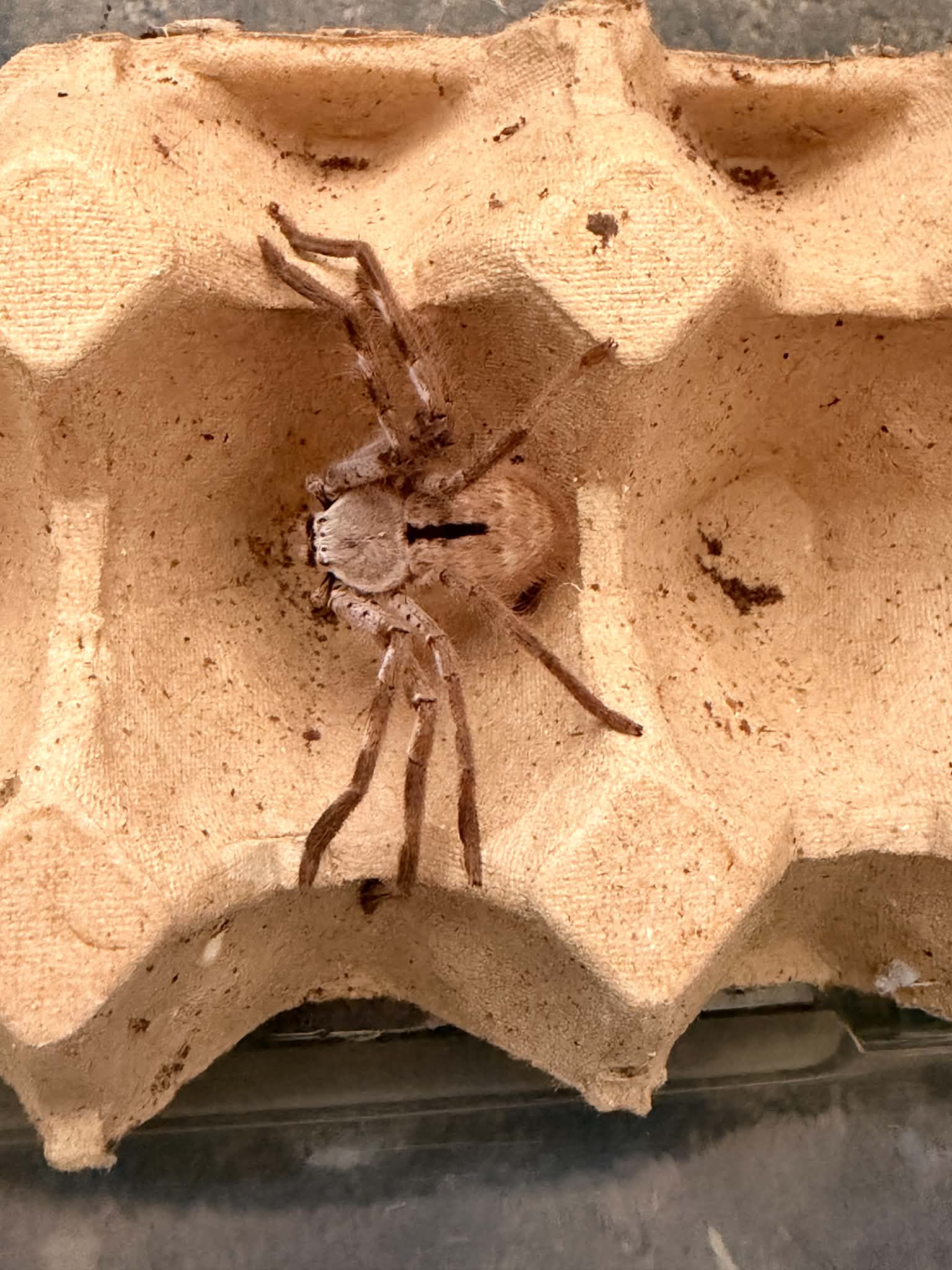
Giant Banded Huntsman Spider (Holconia immanis) Juvinile
The Giant Banded Huntsman Spider (Holconia immanis) is an impressive Australian huntsman spider known for its large size, distinctive banded legs and fast-moving hunting behaviour. Native to eastern Australia, this striking species is popular among arachnid enthusiasts who appreciate large, active spiders with fascinating natural behaviours.
With its flattened grey-brown body, dark abdominal markings and contrasting bands across its hairy legs, the Giant Banded Huntsman has a distinctive appearance that makes it stand out among Australian huntsman spiders. Unlike web-building spiders, this species actively hunts its prey, using its speed and sensitivity to movement to locate and capture insects and other small invertebrates.
Reaching an impressive adult leg span of approximately 16 cm, the Giant Banded Huntsman is an exciting species for keepers looking to expand their collection with a large Australian spider.
Scientific Classification
- Scientific Name: Holconia immanis
- Family: Sparassidae
- Genus: Holconia
- Type: Australian Huntsman Spider
- Common Name: Giant Banded Huntsman Spider
- Adult Body Length: Up to approximately 4.5 cm
- Adult Leg Span: Up to approximately 16 cm
- Lifestyle: Terrestrial / climbing hunter
Appearance
The Giant Banded Huntsman Spider is recognised for its broad, flattened body, long legs and distinctive grey-brown colouration.
Key features include:
- Grey to brown body colouration
- Distinctive dark markings across the abdomen
- Hairy legs with contrasting dark bands
- Long, laterally positioned legs
- Flattened body suited to squeezing into narrow spaces
- Impressive adult size and leg span
Its combination of banded legs and large, flattened body gives the Giant Banded Huntsman a distinctive appearance. These physical characteristics also help it move through narrow crevices and shelter beneath loose bark.
Natural Background
The Giant Banded Huntsman is native to eastern Australia, where it occurs in areas extending from Queensland through New South Wales to Victoria.
It is commonly associated with woodland habitats, tree bark, fallen timber and sheltered spaces around buildings. Its flattened body allows it to hide beneath loose bark and within narrow gaps, where it can remain concealed while waiting for suitable prey.
Rather than constructing a prey-catching web, Holconia immanis relies on its speed, sensory hairs and hunting instincts to locate and capture food. This active hunting behaviour makes it a fascinating species to observe in captivity.
Behaviour
The Giant Banded Huntsman Spider is a fast and agile hunter with a range of interesting behaviours.
Unlike many tarantulas, huntsman spiders are not typically burrow-dependent. They are well adapted to climbing and seeking shelter behind bark, within crevices and against enclosure surfaces.
Behavioural characteristics include:
- Rapid movement when exploring or hunting
- Ability to move sideways across surfaces
- Climbing and hiding behind bark
- Active hunting rather than relying on a prey-catching web
- Sensitivity to air movement and nearby vibrations
- A tendency to retreat into sheltered spaces when disturbed
Although this species may be timid, it can move extremely quickly when startled. Handling is not recommended, and care should be taken when opening its enclosure.
Giant Banded Huntsman Care
The Giant Banded Huntsman requires a secure enclosure that accommodates its climbing behaviour, movement and impressive leg span.
A suitable setup can include:
- A secure, escape-proof enclosure with good ventilation
- Adequate height and floor space for movement
- Cork bark or other suitable climbing and hiding structures
- Appropriate temperature and humidity conditions
- Light misting or another suitable method of providing drinking water
- Protection from direct sunlight and overheating
- Minimal unnecessary disturbance
Unlike burrowing tarantulas, this huntsman benefits from vertical surfaces and sheltered spaces behind bark. The enclosure should provide enough room for the spider to move freely and moult without obstruction.
Avoid excessive moisture and stagnant conditions. Temperature and humidity should be managed according to the needs of the individual spider and its stage of development.
Feeding
The Giant Banded Huntsman Spider is a carnivorous predator that feeds on live insects and other suitably sized invertebrates.
Suitable feeder insects include:
- Crickets
- Woodies
- Cockroaches
- Moths and flies
- Other appropriately sized feeder insects
Prey should be appropriately sized for the spider. Feeding frequency depends on its age, body condition, temperature and activity level.
Remove uneaten prey when necessary, especially if the spider is preparing to moult. Avoid leaving live feeder insects with a spider that is moulting or otherwise vulnerable.
Moulting
Like other spiders, the Giant Banded Huntsman periodically sheds its exoskeleton as it grows. Moulting allows the spider to increase in size and develop its adult characteristics.
Signs of an approaching moult can include reduced activity, changes in feeding behaviour and spending more time in a sheltered position.
During this period, avoid unnecessary disturbance and remove any live prey that could injure the spider. After moulting, allow sufficient time for the new exoskeleton and fangs to harden before resuming feeding.
Providing a secure enclosure with suitable environmental conditions is particularly important during this vulnerable stage.
Growth & Adult Size
The Giant Banded Huntsman is one of Australia’s larger huntsman spiders, with adults reaching a body length of approximately 4.5 cm and a leg span of up to 16 cm.
Growth rate varies according to sex, temperature, feeding frequency and individual genetics. Juveniles gradually increase in size through successive moults, developing their adult proportions as they mature.
Because this species is an active climber, its enclosure should be sized to accommodate its eventual leg span rather than its current body size alone.
Why Keep the Giant Banded Huntsman Spider?
The Giant Banded Huntsman (Holconia immanis) is an excellent addition for enthusiasts interested in large Australian spiders and active hunting behaviour.
Key features include:
- Impressive adult leg span of up to approximately 16 cm
- Distinctive grey-brown colouration and banded legs
- Native Australian species
- Fast and agile hunting behaviour
- Fascinating climbing and shelter-seeking habits
- No reliance on a prey-catching web
- Interesting growth and moulting process
With its impressive size, striking banded legs and dynamic hunting behaviour, the Giant Banded Huntsman Spider is a fascinating species for Australian arachnid enthusiasts. Its unique combination of speed, climbing ability and natural hunting instincts makes it a distinctive addition to a specialist spider collection.