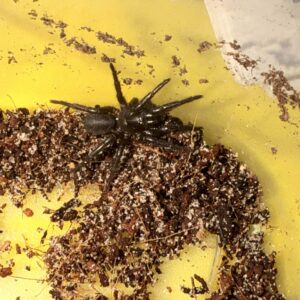
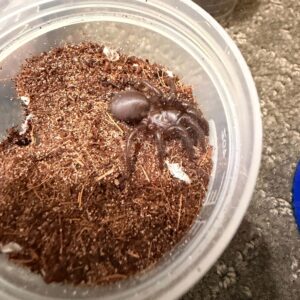
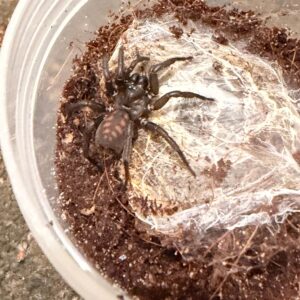
Turret-Building Arbanitis (Arbanitis cf. robertsi)
The Turret-Building Arbanitis (Arbanitis cf. robertsi) is a fascinating Australian trapdoor spider known for constructing distinctive raised “turret” entrances around its burrow. These silk-and-soil structures set it apart from many other trapdoor species and provide both camouflage and sensory advantage.
Scientific Classification
Genus: Arbanitis
Family: Idiopidae
Common name: Turret-Building Trapdoor
Appearance
- Medium-sized trapdoor spider
- Robust, compact body typical of idiopid spiders
- Colouration ranges from earthy brown to dark brown
- Thick legs adapted for digging
- Subtle patterning that blends with soil and leaf litter
They are generally cryptic in appearance, designed for camouflage rather than display.
Habitat & Distribution
Arbanitis cf. robertsi occurs in parts of eastern Australia, typically in:
- Forests and woodlands
- Suburban gardens with suitable soil
- Areas with stable ground for burrow construction
They are most commonly found:
- In soil embankments
- Along forest floors
- In sheltered, undisturbed areas
Behaviour
This species is a sedentary ambush predator that spends most of its life within its burrow.
Its most notable feature is the turret entrance, constructed from:
- Silk
- Soil
- Leaf litter and debris
Diet includes:
- Insects
- Passing arthropods
The spider waits just inside the entrance, detecting vibrations before rapidly lunging out to capture prey.
When disturbed, it retreats deep into its burrow, sealing itself off for protection.
Invertebrate Keeping
Turret-building Arbanitis are highly specialised and best suited for experienced keepers. They require:
- Deep, compact substrate suitable for stable burrows
- Slightly moist conditions (not waterlogged)
- Minimal disturbance to allow turret construction
- Small to medium live prey
Providing the right substrate consistency is critical, as they rely heavily on their ability to build and maintain their burrow and turret.
While rarely seen, they are extremely rewarding for keepers interested in natural behaviours and burrow architecture.