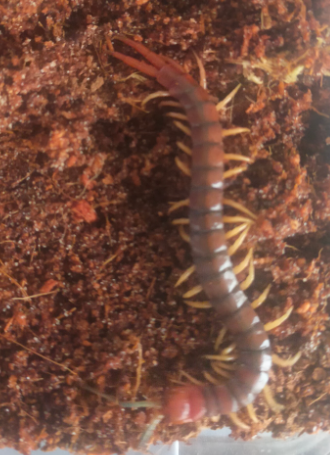
Orange-footed Centipede (Cormocephalus aurantiipes) (color may not exactly same as picture)
The Orange-footed Centipede (Cormocephalus aurantiipes) is a striking Australian centipede known for its distinctive orange legs, elongated segmented body and active predatory behaviour. Found across much of mainland Australia, this species is an appealing addition to a specialist invertebrate collection for keepers interested in native centipedes.
Typically reaching around 10 cm in length, with larger individuals reported at up to approximately 14 cm, the Orange-footed Centipede combines an impressive appearance with the fast-moving behaviour characteristic of the family Scolopendridae. Its colouration can vary depending on locality, with darker body tones contrasting against its orange-coloured legs. <Cite refs={[“turn770056search12″,”turn770056search8″,”turn770056search13”]}/>
Scientific Classification
- Scientific name: Cormocephalus aurantiipes
- Common name: Orange-footed Centipede
- Family: Scolopendridae
- Order: Scolopendromorpha
- Class: Chilopoda
- Type: Terrestrial centipede
Appearance
The Orange-footed Centipede has a long, flattened, segmented body, prominent antennae and numerous pairs of legs. Its most recognisable feature is its orange to reddish-orange legs, which contrast with its darker brown, grey or olive-toned body.
Colouration and patterning can vary between individuals and geographic locations. Its streamlined body allows it to move quickly through leaf litter, soil and narrow spaces beneath bark and rocks.
Habitat and Natural Behaviour
In the wild, Cormocephalus aurantiipes inhabits a variety of environments across mainland Australia. It is commonly associated with sheltered areas such as leaf litter, soil, fallen timber and spaces beneath rocks and bark.
This species is a solitary, ground-dwelling predator that is generally more active at night. It uses its antennae to detect its surroundings and specialised front appendages, known as forcipules, to inject venom and subdue prey.
Its speed and predatory instincts make it fascinating to observe, although it should always be treated as a venomous animal rather than a handling pet.
Care Requirements
The Orange-footed Centipede requires a secure terrestrial enclosure that provides shelter, suitable substrate and access to different moisture levels.
A suitable enclosure should include:
- A tightly secured, escape-proof lid with no gaps
- A layer of moisture-retaining substrate deep enough for burrowing and retreat-building
- Cork bark, leaf litter or other suitable hiding places
- A moisture gradient, with one area kept more humid than another
- Good ventilation while preventing the enclosure from drying out completely
- Stable temperatures appropriate for the species and its source locality
Avoid waterlogged substrate, excessive heat and unnecessary disturbance. Keep the enclosure secure at all times, as centipedes can move quickly and escape through surprisingly small openings.
Feeding
The Orange-footed Centipede is a carnivore that feeds on insects and other small invertebrates. In captivity, suitable feeder insects include appropriately sized crickets and cockroaches.
Adjust feeding frequency to the centipede’s size, body condition and appetite. Remove uneaten prey and food remains promptly, particularly when the centipede is showing signs of an approaching moult.
Moulting and Growth
Like other centipedes, Cormocephalus aurantiipes grows by moulting its exoskeleton. Before moulting, it may become less active, stop feeding or remain hidden for an extended period.
During this time, avoid disturbing the animal and remove live feeder insects that could injure it. Allow the centipede to complete its moult and recover undisturbed.
Exact growth rates and lifespan can vary with individual conditions, temperature, feeding and husbandry.
Handling and Safety
Direct handling is not recommended. The Orange-footed Centipede is fast-moving and venomous, and a bite can cause significant pain and swelling. Use a secure enclosure and avoid unnecessary contact. Any transfer or enclosure maintenance should be planned carefully to minimise the risk of escape or injury.
This species is best suited to keepers who have experience maintaining predatory invertebrates and understand the risks associated with large centipedes.
Why Keep an Orange-footed Centipede?
The Orange-footed Centipede is an excellent choice for experienced keepers who appreciate Australia’s native invertebrate diversity. Its contrasting orange legs, distinctive body pattern and active hunting behaviour make it an interesting species to observe.
With appropriate housing, suitable moisture levels and a consistent feeding routine, Cormocephalus aurantiipes can be a rewarding addition to a specialist centipede collection.