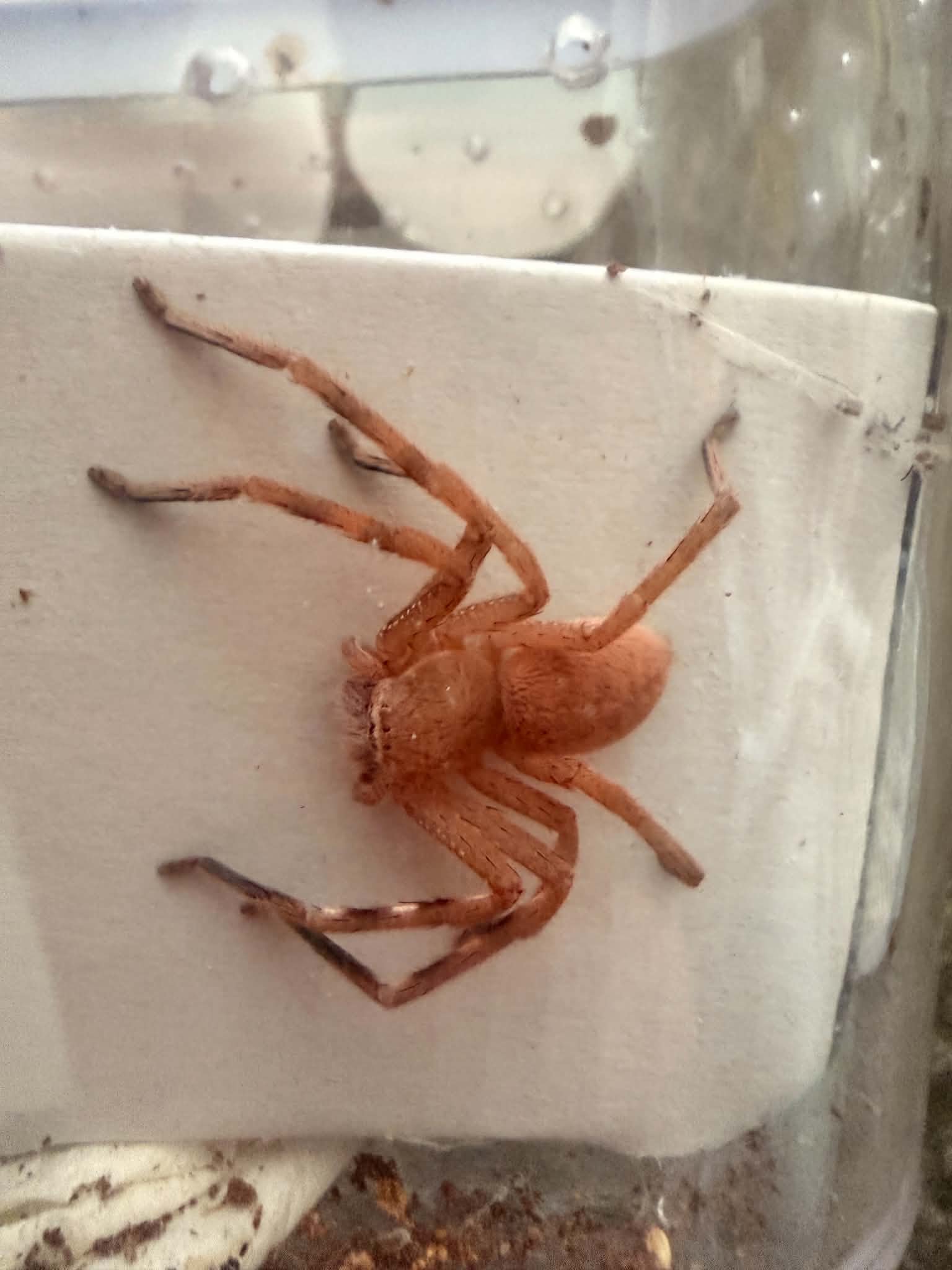
Northern Badge Huntsman (Neosparassus salacius) Sub Adult
The Northern Badge Huntsman Spider (Neosparassus salacius) is a fascinating Australian huntsman known for its distinctive abdominal badge, impressive agility and unique leaf-nesting behaviour. Native to tropical northern Queensland, this species is an excellent addition to specialist spider collections, particularly for keepers interested in Australia’s diverse huntsman spiders.
Unlike many larger huntsman spiders that shelter beneath loose bark, the Northern Badge Huntsman typically lives among foliage, where it creates a silken retreat by binding leaves together. Its relatively compact size, active hunting behaviour and distinctive markings make it an interesting species to observe in captivity.
Reaching a body length of approximately 20 mm and a leg span of around 80 mm, the Northern Badge Huntsman demonstrates that impressive hunting behaviour is not limited to Australia’s largest spiders.
Scientific Classification
- Scientific Name: Neosparassus salacius
- Family: Sparassidae
- Genus: Neosparassus
- Type: Australian Huntsman Spider
- Common Name: Northern Badge Huntsman
- Adult Body Length: Up to approximately 20 mm
- Adult Leg Span: Approximately 80 mm
- Lifestyle: Arboreal / foliage-dwelling hunter
Appearance
The Northern Badge Huntsman Spider is recognised for its distinctive badge-like marking beneath the abdomen and its agile, long-legged build.
Key features include:
- Compact body with long, agile legs
- Darker brown to earthy colouration
- Distinctive badge-like marking on the underside of the abdomen
- Sensory hairs that detect air movement and nearby activity
- Strong climbing ability
- Juveniles that can display bright green colouration
The characteristic abdominal badge gives this species its common name. Badge markings can include contrasting colours, making the underside of the spider particularly interesting to observe.
Juvenile colouration may differ from that of adults, with young spiders often displaying brighter green tones that change as they mature.
Natural Background
The Northern Badge Huntsman is found in tropical northern Queensland, where it inhabits savannah scrub and vegetation containing small trees, shrubs and tall grasses.
Unlike many huntsman species that shelter beneath tree bark, Neosparassus salacius creates a retreat among foliage. It uses silk to bind leaves together, forming a protected space where it can rest, moult and lay eggs.
This specialised nesting behaviour makes the species particularly interesting for keepers who want to observe more than just a spider’s hunting activity. Providing suitable foliage and secure anchor points can help encourage natural retreat-building behaviour in captivity.
Behaviour
The Northern Badge Huntsman is a fast-moving, active hunter that relies on speed and sensory awareness to capture prey.
Its fine sensory hairs help it detect air movement and vibrations, allowing it to respond to nearby prey and potential threats.
Behavioural characteristics include:
- Rapid movement across foliage and enclosure surfaces
- Strong climbing ability
- Leaf-binding and silken retreat construction
- Active hunting rather than relying on a prey-catching web
- Sensitivity to air movement and vibrations
- Potentially defensive behaviour when disturbed
Like other huntsman spiders, this species can move quickly and may be difficult to recapture if it escapes. It is best suited to observation rather than handling, and its enclosure should be opened carefully.
Northern Badge Huntsman Care
The Northern Badge Huntsman requires a secure, well-ventilated enclosure that accommodates its climbing and foliage-dwelling lifestyle.
A suitable setup can include:
- A secure enclosure with a tight-fitting lid
- Vertical branches and climbing structures
- Artificial or pesticide-free natural foliage
- Leaves or similar structures for building a silken retreat
- Appropriate temperature and humidity
- Light misting to provide drinking opportunities
- Good ventilation to prevent stagnant, excessively damp conditions
Unlike terrestrial tarantulas, this species benefits from vertical space and foliage rather than deep burrowing substrate. Providing several leaves or overlapping foliage can encourage natural retreat-building behaviour.
As a tropical species, it should be maintained under conditions appropriate to its northern Queensland origins. Avoid sudden environmental changes, overheating and excessive moisture.
Feeding
The Northern Badge Huntsman Spider is a carnivorous predator that feeds on insects and other small invertebrates.
Suitable feeder insects include:
- Small crickets
- Small woodies
- Appropriately sized cockroaches
- Moths and flies
- Other suitable live feeder insects
Prey should be appropriately sized for the spider. Smaller specimens require smaller feeders, while larger individuals can accept larger prey items.
Remove uneaten prey when necessary, particularly if the spider is preparing to moult. Avoid leaving live insects in the enclosure while the spider is moulting or otherwise vulnerable.
Moulting
Like all spiders, the Northern Badge Huntsman periodically sheds its exoskeleton as it grows.
During pre-moult, it may become less active, stop feeding or spend more time within its silken retreat. These behaviours can indicate that a moult is approaching.
This species benefits from secure anchor points beneath leaves or branches, where it can suspend itself during moulting. Avoid disturbing the spider during this vulnerable period and allow its new exoskeleton to harden before offering food again.
Maintaining suitable environmental conditions and providing an undisturbed retreat are important parts of successful care.
Growth & Adult Size
The Northern Badge Huntsman is a moderately sized huntsman spider, reaching a body length of approximately 20 mm and a leg span of around 80 mm.
Growth occurs through successive moults, with juveniles gradually developing adult colouration and proportions. Growth rate varies according to temperature, feeding frequency, sex and individual genetics.
Males and females can differ in appearance as they mature. Adult males may have a slimmer build and longer-looking legs, while females may have a more robust body.
Why Keep the Northern Badge Huntsman?
The Northern Badge Huntsman Spider is an appealing species for enthusiasts interested in Australia’s native spiders and specialised hunting behaviours.
Key features include:
- Distinctive badge-like abdominal markings
- Australian species native to tropical northern Queensland
- Compact size with an approximately 80 mm leg span
- Fascinating leaf-binding and silk-nest construction
- Active hunting behaviour
- Interesting juvenile colour changes
- Opportunity to observe natural moulting and nesting behaviours
With its unique leaf-nesting habits, distinctive markings and agile hunting style, the Northern Badge Huntsman (Neosparassus salacius) is a fascinating addition to a specialist Australian spider collection. Its combination of manageable size and interesting natural behaviour makes it particularly appealing to keepers who enjoy observing the more unusual habits of huntsman spiders.