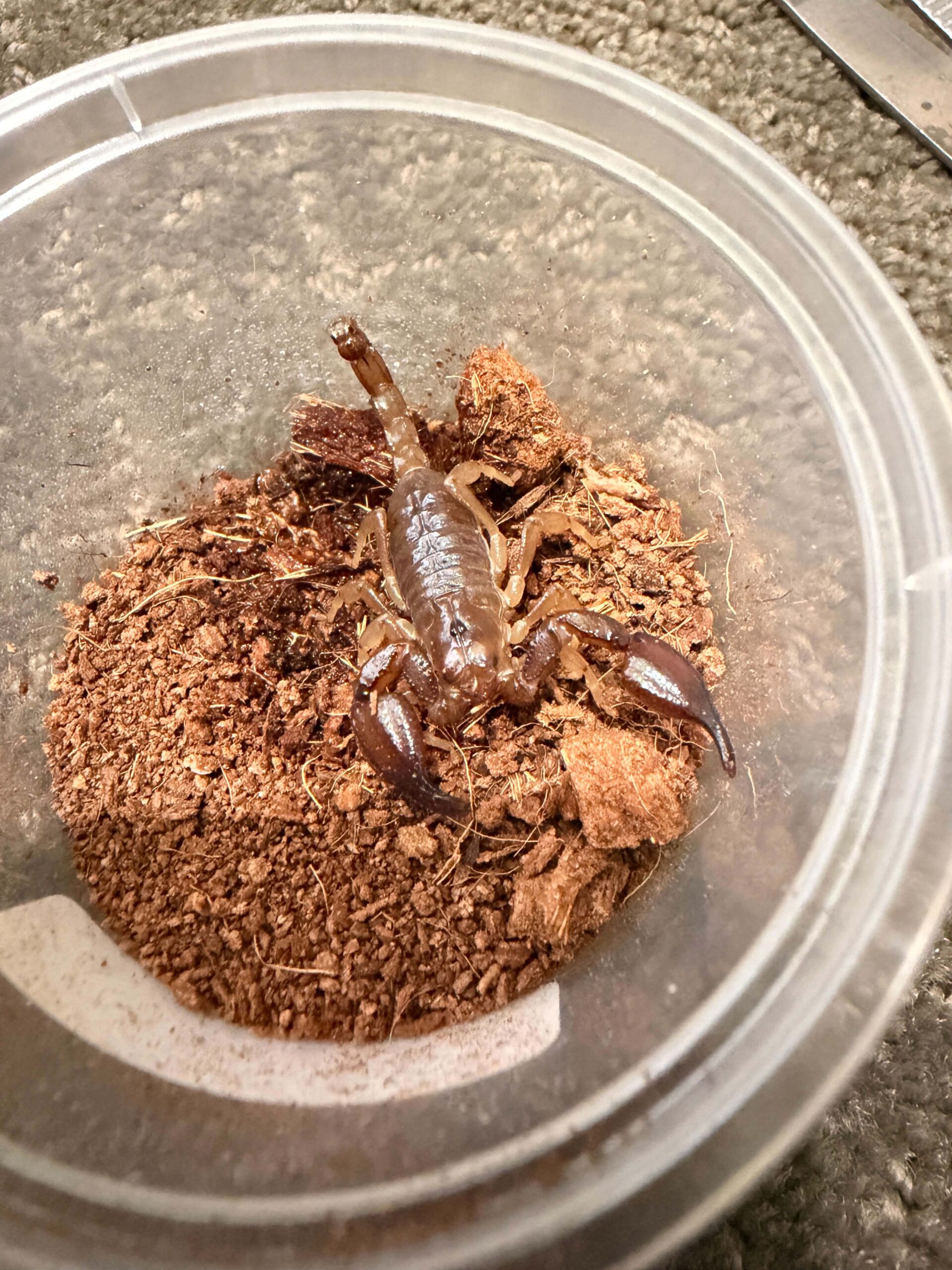
Black Rock Scorpion Urodacus Manicatus
The Black Rock Scorpion (Urodacus manicatus) is a robust Australian burrowing scorpion recognised for its dark, glossy appearance, powerful pincers, and fascinating underground lifestyle. Native to southern Australia, this impressive species is commonly associated with rocky habitats, dry woodland, scrubland, and areas where suitable soil allows it to construct protective burrows.
Its combination of dark colouration, strong chelae, and interesting nocturnal behaviour makes the Black Rock Scorpion a popular choice among Australian invertebrate enthusiasts and experienced scorpion keepers.
Scientific Classification
Genus: Urodacus
Species: Urodacus manicatus
Family: Urodacidae
Common Name: Black Rock Scorpion
Type: Australian Burrowing Scorpion
Appearance
Urodacus manicatus has a robust body and powerful pincers that are well adapted to its burrowing and predatory lifestyle.
- Medium to large-sized Australian scorpion
- Dark brown to black colouration
- Slightly glossy exoskeleton
- Thick and powerful pincers (chelae)
- Sturdy, heavily segmented body
- Relatively short, curved metasoma (tail)
- Prominent stinger at the end of the tail
Its dark colouration and heavily built body give the Black Rock Scorpion a distinctive appearance, while its powerful pincers are particularly well suited to gripping prey and manipulating soil while constructing its burrow.
Habitat & Distribution
The Black Rock Scorpion is native to southern Australia and occurs across areas of Victoria, South Australia, and parts of New South Wales.
It can be found in a range of dry and semi-arid environments, including:
- Dry woodlands
- Open forests
- Scrublands
- Rocky habitats
- Areas beneath rocks and logs
- Firm soils suitable for burrowing
Urodacus manicatus is strongly associated with shelter and underground retreats. Individuals may shelter beneath rocks, logs, and other debris or construct their own burrows within suitable soil.
A firm substrate is particularly important because burrowing provides protection from predators, environmental conditions, and temperature fluctuations.
Behaviour
The Black Rock Scorpion is primarily nocturnal, spending much of the day concealed within its burrow or beneath natural shelters before emerging after dark to hunt.
As an ambush predator, it relies heavily on its sensory organs to detect movement and vibrations from nearby prey.
Its diet can include:
- Crickets
- Cockroaches
- Insects
- Spiders
- Other small arthropods
- Other suitable invertebrates
The powerful pincers are used to seize and subdue prey, while the stinger may be used when additional immobilisation is required.
When threatened, Urodacus manicatus may raise its tail and pincers into a defensive posture. Although generally not considered an aggressive species, it can sting if provoked or handled.
Black Rock Scorpion Care
Black Rock Scorpion care should focus on recreating the dry, sheltered environment in which Urodacus manicatus naturally lives.
A suitable enclosure should provide:
- Dry to slightly humid conditions
- Good ventilation
- Deep substrate suitable for burrowing
- Firm substrate that can hold a stable burrow
- Rocks, bark, or other secure hides
- A suitable temperature gradient
- Appropriately sized live insects
Providing sufficient substrate depth is particularly important for this burrowing Australian scorpion, as individuals may spend extended periods underground.
Avoid keeping the enclosure excessively wet or poorly ventilated. A suitable moisture gradient can provide a choice of microclimates while allowing the main enclosure to remain relatively dry.
Feeding
Black Rock Scorpions are carnivorous predators and should be offered appropriately sized live prey.
Suitable feeder insects can include:
- Crickets
- Wood roaches
- Other suitable cockroaches
- Other appropriately sized feeder insects
The scorpion’s powerful pincers are used to capture and hold prey while the stinger can assist in subduing it.
Feeding frequency will vary depending on the individual, age, environmental conditions, and prey availability. Uneaten prey should not be left in the enclosure for extended periods.
Burrowing Behaviour
One of the most fascinating aspects of keeping Urodacus manicatus is its burrowing behaviour.
A suitable enclosure with deep, firm substrate allows the scorpion to construct and maintain a secure underground retreat. The burrow provides a protected microhabitat where the scorpion can shelter during the day and regulate its exposure to environmental conditions.
For keepers, allowing the scorpion to construct its own burrow is preferable to repeatedly disturbing or excavating its retreat.
Housing
The Black Rock Scorpion is generally best housed individually because it can be territorial and may attack other scorpions.
An appropriate enclosure should include:
- Secure ventilation
- Escape-resistant construction
- Deep burrowing substrate
- At least one secure hide
- Stable environmental conditions
- Easy access for feeding and maintenance
Handling should be avoided where possible. Scorpions are best observed within their enclosure rather than routinely handled.
Venom & Safety
Like other scorpions, Urodacus manicatus possesses venom and should be treated as a venomous Australian invertebrate.
Although its venom is not generally regarded as being among Australia’s most medically significant scorpion venoms, individual reactions can vary.
For safety:
- Do not handle the scorpion unnecessarily
- Avoid deliberately provoking it
- Use appropriate tools when maintenance is required
- Keep the enclosure securely closed
- Do not allow children or inexperienced individuals to handle the animal
- Follow all applicable Australian state and territory regulations
Anyone keeping native Australian scorpions should understand the relevant local requirements and use appropriate safety precautions.
Why Keep Black Rock Scorpions?
The Black Rock Scorpion is an excellent choice for experienced enthusiasts interested in Australian native scorpions, burrowing invertebrates, and nocturnal predators.
Key features include:
- Native Australian scorpion
- Distinctive dark brown to black colouration
- Robust, heavily armoured body
- Powerful digging and gripping pincers
- Fascinating burrowing behaviour
- Primarily nocturnal
- Effective ambush predator
- Hardy species when appropriately housed
- Interesting addition to an Australian invertebrate collection
- Excellent species for observing natural scorpion behaviour
For enthusiasts looking for an Australian black scorpion with fascinating burrowing behaviour, Urodacus manicatus offers an impressive combination of dark colouration, powerful morphology, nocturnal activity, and natural hunting behaviour. Its specialised underground lifestyle makes it a particularly interesting species for experienced Australian invertebrate keepers.