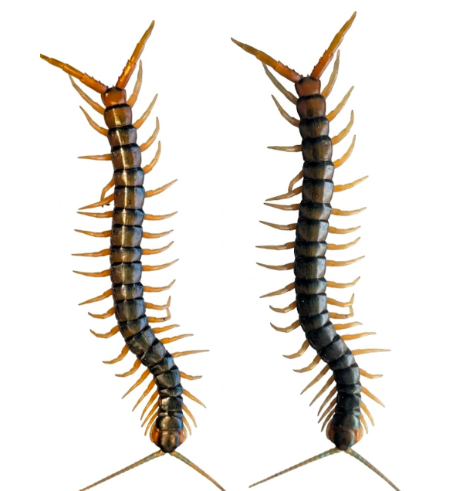
Ethmostigmus rubripes (New England Dark Tiger)
(color may not exactly same as picture)
The Ethmostigmus rubripes (New England Dark Tiger) is a striking form of the Australian giant centipede, valued by experienced invertebrate keepers for its dark colouration, distinctive segmented body and active predatory behaviour. This large centipede belongs to the family Scolopendridae and is an impressive example of Australia’s diverse native myriapods.
The New England Dark Tiger is a locality or hobby form of Ethmostigmus rubripes. Individual colouration and patterning can vary, making each specimen unique. As a fast-moving, venomous predator, this species is best suited to experienced keepers who can provide secure housing and observe it without direct handling.
Scientific Classification
- Scientific name: Ethmostigmus rubripes
- Common name: New England Dark Tiger Centipede
- Family: Scolopendridae
- Order: Scolopendromorpha
- Class: Chilopoda
- Type: Terrestrial centipede
Appearance
The New England Dark Tiger is recognised by its elongated, segmented body, numerous legs and prominent antennae. This darker form is associated with deep, contrasting body tones and a tiger-like pattern across its body segments, complemented by coloured legs.
As with other Ethmostigmus rubripes forms, the exact shades and contrast may differ between individuals. The species can grow to a substantial size, with published accounts reporting lengths around 16 cm and some individuals reaching greater lengths.
Habitat and Natural Behaviour
Ethmostigmus rubripes occurs across a range of Australian habitats, where it shelters beneath logs, rocks, bark and leaf litter. It is primarily a nocturnal hunter and may become more active during warm, humid conditions.
This species uses its sensitive antennae to detect prey and its modified front legs, known as forcipules, to deliver venom. It is a capable predator that hunts insects and other small animals. Its speed and defensive response make it fascinating to observe, but it should always be treated with caution.
Care Requirements
The New England Dark Tiger requires a secure, well-ventilated enclosure with suitable substrate, shelter and a moisture gradient. The enclosure must have a tightly fitting, escape-proof lid, as centipedes can squeeze through surprisingly small gaps.
A suitable setup should include:
- A secure enclosure with no gaps around the lid or ventilation panels
- Several centimetres of substrate, such as coco peat, for burrowing and moisture retention
- Bark or another suitable shelter
- A moist area and a comparatively drier area so the centipede can select its preferred conditions
- Light misting or a safe, shallow water source
- Stable temperatures and good ventilation without allowing the enclosure to dry out completely
Avoid excessive heat and waterlogged substrate. Husbandry should be adjusted to the needs of the individual and its locality form.
Feeding
The New England Dark Tiger is a carnivorous hunter that can be fed appropriately sized live feeder insects, such as crickets and cockroaches. Feeding frequency should be adjusted to the centipede’s size, body condition and appetite.
Remove uneaten prey and food remains promptly. Avoid leaving live feeder insects in the enclosure when the centipede is preparing to moult, as disturbance during this vulnerable stage can cause serious problems.
Moulting and Growth
Like other centipedes, Ethmostigmus rubripes grows by shedding its exoskeleton. Before moulting, it may stop feeding and become less active or retreat into a sheltered area. After moulting, its new exoskeleton needs time to harden, so it should be left undisturbed.
Captive lifespan is commonly reported at around three to five years, although longevity can vary with husbandry and individual circumstances.
Handling and Safety
Direct handling is not recommended. Ethmostigmus rubripes is fast, venomous and capable of delivering a painful bite. Keep the enclosure securely closed, avoid unnecessary disturbance and use a safe, controlled method of containment if the animal must be moved. This species is best suited to experienced keepers who understand the risks associated with large centipedes.
Why Keep a New England Dark Tiger?
The New England Dark Tiger is an excellent choice for experienced keepers interested in large Australian centipedes, distinctive locality forms and active predatory invertebrates. Its dark tiger-like pattern, alert behaviour and impressive hunting adaptations make it a standout observation species.
With secure housing, appropriate moisture and temperature management, and careful feeding practices, this centipede can be a rewarding addition to a specialist invertebrate collection.